Xploration • Curation • Recommendation


Thorpy and Dan Coggins Revive the Lovetone Doppelgänger 4-Stage Analog Twin-Oscillator Phaser & Vibrato, now in high-fidelity tour-grade edition around half the size of the original


Key Points
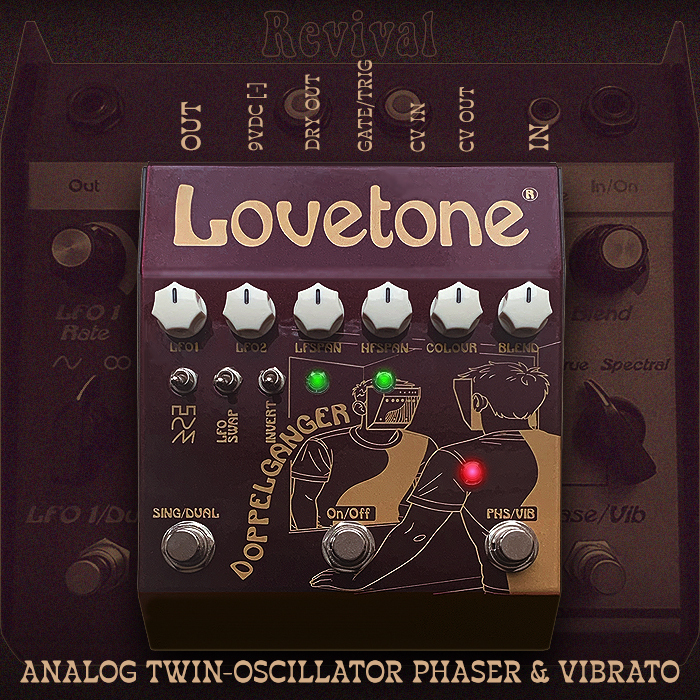
Thorpy and original Lovetone engineer Dan Coggins revive the near-identical, high-fidelity 4-stage twin-LFO phaser/vibrato. Its steel enclosure measures 128 × 154 × 72mm—53% of the original’s size (200 × 185 × 83mm)—but weighs 1.1kg versus 600g; the wings are removed.
LF/HF Span reposition the two pairs of notch filters; Colour is resonance and Blend intensity. CV in/out, gate/trigger and dry out add connectivity. The interactive controls benefit from the manual’s recommended settings; all controls maxed produce pseudo ring mod.
Vibrato is included; Thorpy’s Pulse Doppler is the simpler option. As of 2026, the webstore price was £350 ($449 / €419); original pedals sell second-hand for around £1,000.
This has been a long time coming, and had to withstand a number of Logistical and Trademark challenges to become a reality. The production journey was beset by some tough decisions, and some last minute surprise competition from Behringer - all of which impacted the timings and final execution of this project.
The general missions though was to bring back the classic Lovetone Doppelgänger circuit - nigh identical in makeup to the original - with the same high fidelity output, but with some modern enhancements for a more robust and reliable operation. The originals were obviously very large and imposing boxes - whose winged construction turned out not to be particularly reliable on the road. And generally the pedals were too large to comfortably fit on a touring board.
So a core part of the mission was to make the Doppelgänger entirely bullet-proof and reasonably sized - to empower those musicians that loved them to more easily be able to take them on the road with them.
- Original Doppelgänger Dimensions : 200 x 185 x 83mm
- 2026 Doppelgänger Dimensions : 128 x 154 x 72mm
- New one is 53% the size of the original!
- Original Doppelgänger Weight : 600g
- New 2026 Edition Weighs 1.1kg (steel enclosure)
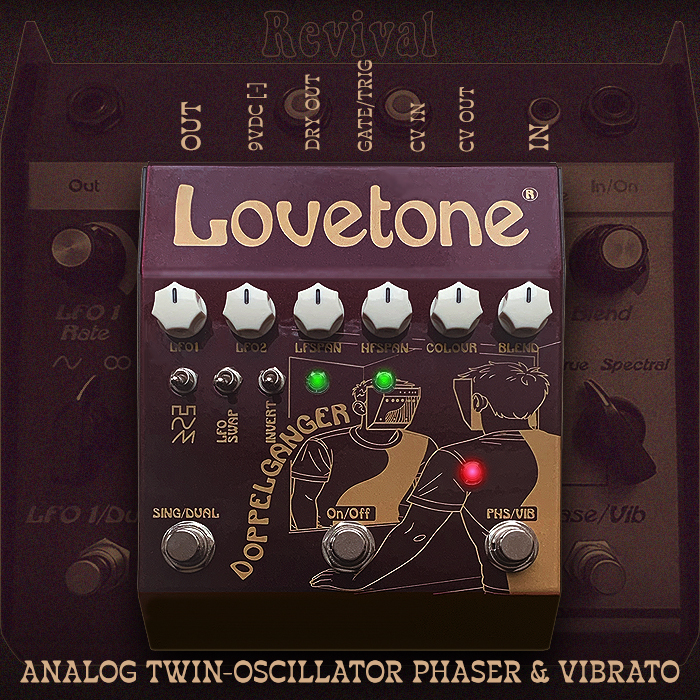
The first thing many of the original Doppelgänger fans are going to observe - is that the raised wings are now gone - the new enclosure is a more robust design - made to fully withstand the rigours of touring. And also the typical silver-top knobs have been replaced here by white Heptagonal MXR-style varieties.
I had an in-depth conversation with Thorpy about the various design choices for this new edition - and the focus here was always on performance, and a tour-grade durability and reliability - while delivering the full fat flavours of the original.
We talked about the possibility of magnetic wings that you could stick on for home / studio use, and then remove for when on the road - that remains a strong possibility. And there may well be some different knob variants available in the not too distant future.
Those development cycles always take longer to complete than is entirely practical - and require numerous iterations to get 100% right - and there are always delays to the final production run. So hopefully there will be further options early into next year.
Obviously the late sudden arrival of Behringer Lovetone clones threw something of a spanner into the works, and delayed the scheduled launch further. While these authentic Lovetone revivals / reissues featured here - are made by the original Lovetone Engineer Dan Coggins, and are very different animals to those Behringer knock-offs! The now fully trademarked Lovetone pedals are full fat high fidelity devices, made with the very best components for the very best quality of output. There are some modern manufacturing concessions to the production - while the nature of the original circuit has been kept intact. The Behringer variants will always be somewhat weak sauce knock-offs. They’re also around the same dimensions as the originals - and so not at all pedalboard or touring friendly, unlike these high fidelity Lovetone revivals!
These were obviously very much a pedal of their era - and the 90’s certainly had some idiosyncrasies - such that there is a degree of complexity in the operation of those pedals. And you’re best off really to start by dialling in the recommended settings first, as it’s not always easy to navigate these pedals without understanding the function of each control, and the relationships between each. There’s a lot of interactivity here between functions and controls, and a lot to get your head around!
Controls - LFO1 Rate, LFO2 Rate, LF Span (Position of 2 Lower Notch Filters), HF Span (Position of 2 Higher Notch Filters), Colour (Resonance), Blend (Intensity, not conventional Dry>Wet Mix), Waves : Square / Sine / Ramping, LFO Swap (Second LFO regulates First in Dual Phaser Action), Invert (Invert Pairs of Notch Filters), Sing/Dual Footswitch (Single or Dual LFO’s), On/Off Footswitch, Phaser/Vibrato Mode Footswitch (impacts nature of Blend).
Rear Ports - 1/4" TS In, 1/8" TRS CV Out, 1/8" TRS CV In, 1/8" TRS Gate/Trigger (LFO1 Reset), 1/4" TS Dry Out (for Wet/Dry setup), 9V DC [-] 40mA, 1/4" TS Out.
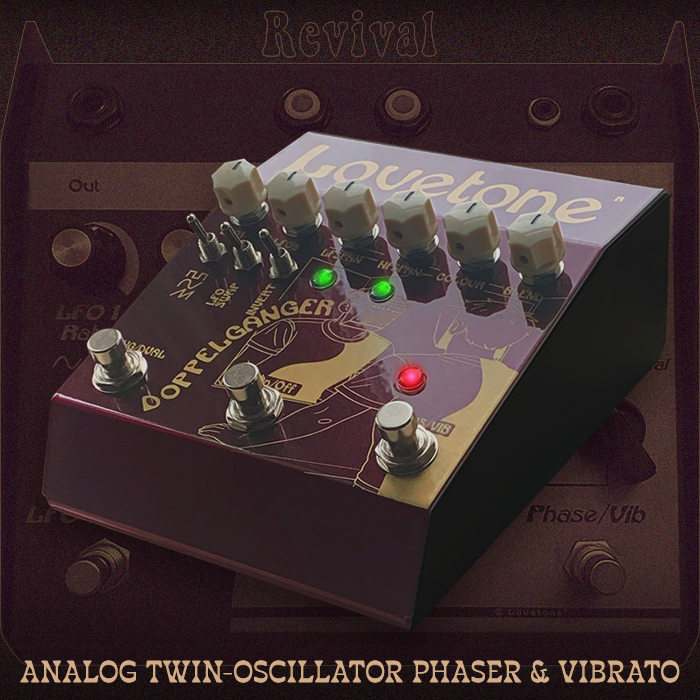
Essentially you have Dual LFO 4-Stage Phasers, where the Second LFO regulates the first for the Dual Mode. LFO1 and LFO2 are simply the Speeds / Rates of the 2 LFO's.
LF Span and HF Span are to do with the 2 pairs of Notch Filters. This is a 4-Stage Phaser type - meaning 4 Notch Filters. Where for a Phase 90 those Notch Filters are fixed and equidistant. While for the Doppelgänger they are split into 2 pairs - a Low Frequency Pair, and High Frequency Pair - where the LF Span and HF Span let you move those positions around for different output effects. You can even invert the filters by dialling the LF Span all the way Up, and the HF Span all the way Down. Also just flip the Invert toggle-switch with flips those two around. So LF Span and HF Span are the relative positions of the 2 Lower and 2 Higher Notch Filters!
Colour is then just Resonance Really, and Blend is a very unique control - which you should think of as Intensity. If you're after a fuller flavour - Colour and Blend are typically Maxed out - in fact I mostly keep those there!
We then have the 3 toggle-switches which cover the LFO Waveform types, LFO1/LFO2 Swap (the other LFO regulates Dual Mode Function), And Invert - for flipping the positions of the 2 Pairs of Notch Filters.
Like I said - it can be a little tricky to dial things in blind - you're best starting off with the two suggested recommended settings - and then tweaking from there. I tried to dial the pedal in blind - and I got it totally wrong - it all snapped into place though when I followed Thorpy's recommended settings - as set out in the Manual!
Starting Phase/Vibe Settings - LFO1 @ Noon, LFO2 @ Max, LF Span @ 3 o'c, HG Span @ 3 o'c, Colour @ Max, Blend @ Max, Wave : Sine, LFO Swap Up, Invert Up.
I just tweaked those settings very slightly - LFO1 moved to 10:30 o'c, LFO2 moved to 3 o'c, and LF Span moved to 9 o' - those are my default Phaser settings.
Starting Pseudo Ring Mod Settings - All dials on Max!, and all-3 switches Up!
This gives you that classic clangy RingMod sound. I'm not necessarily the biggest fan of that. RingMod for me is best when paired with some gain, or ideally paired with a Grand Piano a la Stockhausen. You're typically best off using more subtle flavours of ring modulation - for a more blended approach.
The Vibrato Mode sounds pretty decent, but I'm here mostly for the Phasing, and the ability to flip between the two LFO variants.
Compact, Robust, Precise and High-Fidelity are the best descriptors for this new generation of Lovetone. You can really feel the quality when operating the pedal - those potentiometers have just the right degree of resistance - they feel fantastic. Everything feels very precise and direct. It wholly carries the full fat feel of the original - in a more robust, more pedalboard-friendly enclosure.
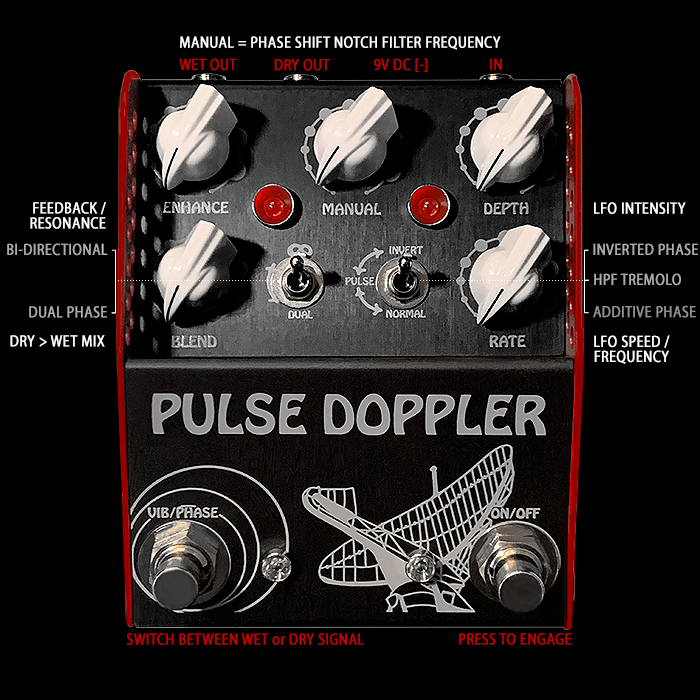
It still has most of its 90's idiosyncrasies - if you want a simpler more modern take on the Doppelgänger - try Thorpy's excellent Pulse Doppler Phaser. While if you want the original experience in a more convenient, robust, reliable and precise form factor - then the 2026 Doppelgänger is the perfect choice!
There are a great number of celebrity musicians that love the original Lovetone pedals, and they're all seemingly fully into an onboard with these new editions. You're bound to see some of those celebrated pedalboards updated real soon!
I feel there will be some criticism from certain quarters of the Lovetone fan club - for the aesthetics of the new pedals - particularly concerning the lack of 'wings' and the lack of 'silver top' knobs - which many consider iconic elements of the originals. You will need to decide for yourself as to how you feel about those changes. I believe there are plans afoot to give you further options in the relatively near future. Where you will likely get options on different variants of knobs, and perhaps even some stick-on magnetic wings!
I personally have already acclimatised to the new looks - the quality of finish here is superb - including the sparkly paint job - while not everyone is necessarily going to be delighted about the aesthetics. The core mission though, as mentioned - was to make these robust, reliable, and tour-friendly - and that very much is the case.
The 2026 Doppelgänger has much more connectivity and more control-ability than the original. It has been designed to be the ideal format for integrating into a robust touring pedalboard rig - for those that want to / need to take the show on the road!
The new Lovetone Doppelgänger goes for $449 / €419 / £350 on the Lovetone FX Webstore - where second-hand versions of the original are around £1,000 on Reverb.com.
The Doppelgänger sounds fantastic with my settings, and was the first Lovetone I really gravitated towards!
Demos